By Jenny McBean, Insight Director and Head of Gaming at Bryter
Women make up nearly half of gaming’s audience, yet the industry still designs, markets and moderates as if they were a niche audience. That disconnect matters in an entertainment industry whose growth continues to be driven by gaming, increasing year by year across billions of players.
Since 2018, Bryter's Women Gamers Study has tracked how women play, spend and shape gaming. In this ninth edition, we surveyed n=1,004 women PC and console gamers aged 16–65, split evenly across the UK and US.
The findings point to a shift in how women engage with gaming: they are broadening the genres they play while concentrating on fewer platforms and potentially moving back towards solo play. Close-knit networks help shape what they discover next. Yet changing habits sit alongside a persistent barrier: toxicity still affects over half of women gamers, particularly Gen Z
Gamer identity
In 2026, reluctance for women gamers to associate with the label ‘gamer’ has crept back. 29% of women gamers say they wouldn't call themselves a gamer, up from 24% in 2025.
Old stereotypes and gatekeeping help explain why women may reject the 'gamer' identity rather than games themselves. 42% of women gamers have been told by their male counterparts that they simply 'don't belong' in a gaming space, which has risen to 71% among Gen Z .
Changing play behaviours
Women gamers’ tastes have changed over the years, and the majority are now playing a broader variety of genres – in 2026, the average woman gamer plays 6 different genres.
Battle Royale has seen the largest rise, up 14% to 39%, followed by Life Simulation, up 12% to 44%. Sports and shooters have also risen significantly in popularity. Among Gen Z gamers, Life Simulation (62%) and Horror (45%) stand out: two genres at opposite emotional ends of the spectrum. One possible explanation is their shared capacity for immersive engagement, with multiplayer gameplay also offering opportunities to clip and share memorable moments.
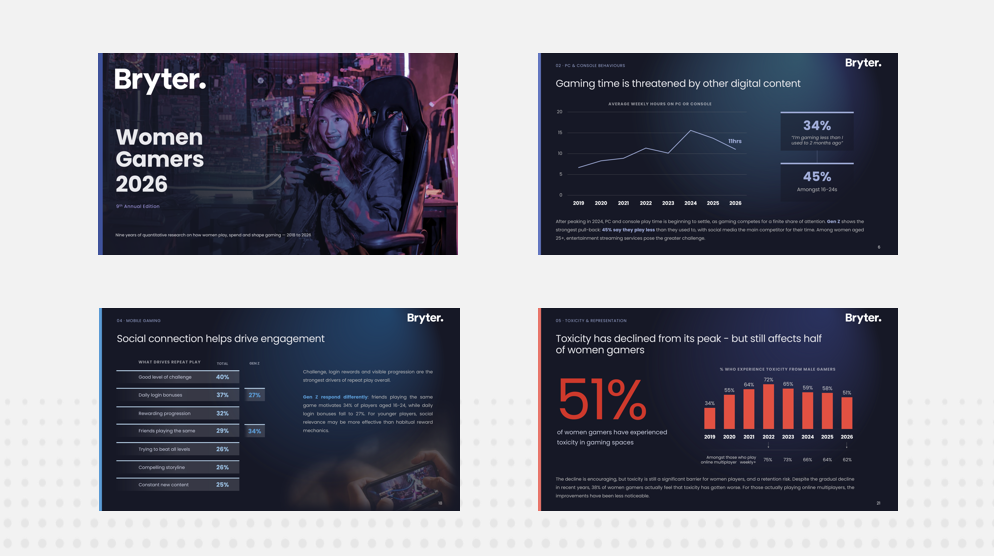
However, gaming is now competing for a finite share of attention: social media being the main rival for Gen Z, while streaming services pull harder on women aged 25+. After peaking at 15.6 hours a week in 2024, PC and console play has settled at 11 hours a week in 2026, with 34% saying they're gaming less than they used to, rising to 45% of 16–24s.
Motivations
Across all age demographics, exploration remains one of the top motivations for women gamers, though this varies with age. Younger audiences value game character connection and fast paced gameplay while older audiences value a deep storyline, while mastering their skill set for progression.
The way women want to play is changing too. Peaking in the pandemic, online multiplayer has seen a gradual decline since 2024, with 50% of women gamers now preferring solo play, up from 40% in 2024, and only 25% preferring multiplayer. Even Gen Z, the most multiplayer-inclined players, lean towards solo play (45%).

Discovery
When it comes to choosing what to play next, social validation is becoming more and more important. Rather than the sole focus being on the official trailers and announcements, players are looking for more ‘authentic’ opinions, and this takes slightly different forms across age groups. Younger players look to gameplay videos and streamers for validation, while older players lean on word of mouth and franchise familiarity.
69% of women gamers follow gaming creators or streamers. While they don’t watch purely for game discovery, personality keeps viewers watching, with a sense of humour (50%) ranking ahead of the games a creator plays (41%).
Toxicity
The picture on toxicity is mixed. Overall levels have improved slightly, yet 38% of women gamers feel toxicity has become worse. Among women who play online multiplayer weekly, the improvement is less noticeable: 62% still experience toxicity. Gen Z gamers remain the most exposed, at 79%.
Verbal abuse is the most common form of toxicity women gamers experience while playing online, reported by 38%. It ranges from sexist remarks to threats of real-world stalking and attacks. A noticeable rise in incel language reinforces the same exclusionary message: that women do not belong in gaming.
Reporting is a big challenge. 42% of those who experience toxicity rarely or never report it, and of those who do, only 24% were satisfied with the outcome.
The cost of this leads to:
- 31% Women gamers play only in close knit communities
- 22%-24% avoid revealing their gender or speaking when playing multiplayer games
- 13% avoid multiplayer games altogether
Women need to believe their experience will be met with the appropriate amount of seriousness. Until reporting is simple and the consequences are visible, the industry will keep losing engagement from one of its most valuable audiences.
Summary
For the industry, the challenge is to respond to how women actually play: across a widening range of genres, with different motivations by age and growing interest in solo experiences. Discovery strategies need to reflect the influence of trusted voices and close-knit networks. Safety is part of that response, not a separate issue.
Download the full Women Gamers 2026 Report here
Get in touch
Want to build a better understanding of key categories and target audiences? Get in touch here with one of the insights team to learn more about our gaming research methodologies and how insights can inform future development and strategies.
Learn
Read more about Bryter's Women Gamers Study across the years on our dedicated Women Gamers page.
web browser, url, browser, computer network, requests, malicious software, captcha, javascript, network connection, page checks