
Introduction
Smartphones have become a near universal presence in the lives of children and young people in the UK. For many families, they are now an everyday tool for communication, learning and entertainment. At the same time, their rapid adoption has raised growing questions about the role smartphones play in children’s wellbeing, development and social lives.
In recent years, children’s smartphone use has become an increasingly contentious issue for parents, schools and policymakers alike. Schools are grappling with how best to manage phone use during the school day, with many introducing or strengthening restrictions in response to concerns about distraction, bullying and online harm. Beyond the school gates, parents face difficult decisions about when to give a child a smartphone, how much access is appropriate, and how to balance the perceived benefits with potential risks.
These debates have moved firmly into the public and political arena, with calls for clearer government intervention, including stronger guidance or regulation on mobile phone use in schools and proposals to restrict or ban access to social media for children under the age of 16. Supporters argue that such measures are necessary to protect children from online harms, while others raise questions about practicality, enforcement and unintended consequences. Together, these discussions reflect a broader uncertainty about how society should respond to the growing presence and influence of smartphones in childhood.
Against this backdrop, Bryter has conducted a nationally representative survey of 2,117 UK adults aged 18+ to explore attitudes towards children’s smartphone ownership and use. The research seeks to understand how adults perceive the benefits and risks of smartphones for children, where responsibility for managing use is seen to lie, and the extent to which there is support for intervention by schools, technology companies or government to limit access to these devices.
Smartphones dominate irrespective of age
The vast majority of UK adults (96%) own a smartphone, with 3% claiming to own a basic feature phone and only 1% saying they do not currently own a mobile phone.
The story for children is somewhat different as device ownership is much lower for young children and then increases with age. Smartphones however are the most popular form of device when a child does get a phone, irrespective of age.
Only 17% of children under the age of 5 own a mobile phone, but amongst those that do own a phone the split is 61% smartphone vs 39% feature phone.
As the age of the child increases so too does the proportion that own a mobile phone, but the pattern of which device is owned remains consistent. Smartphones dominate, accounting for 74% of mobile phones for 5-10 year olds, 92% for 11-15 year olds and 93% for 16-17 year olds.
Good intentions don’t translate into actions
When parents are asked when they intend to buy their children a mobile phone we can see that a significant minority of parents with a child under 5 (25%) and parents with a child aged 5-10 (14%) say that they will never buy their child a phone.
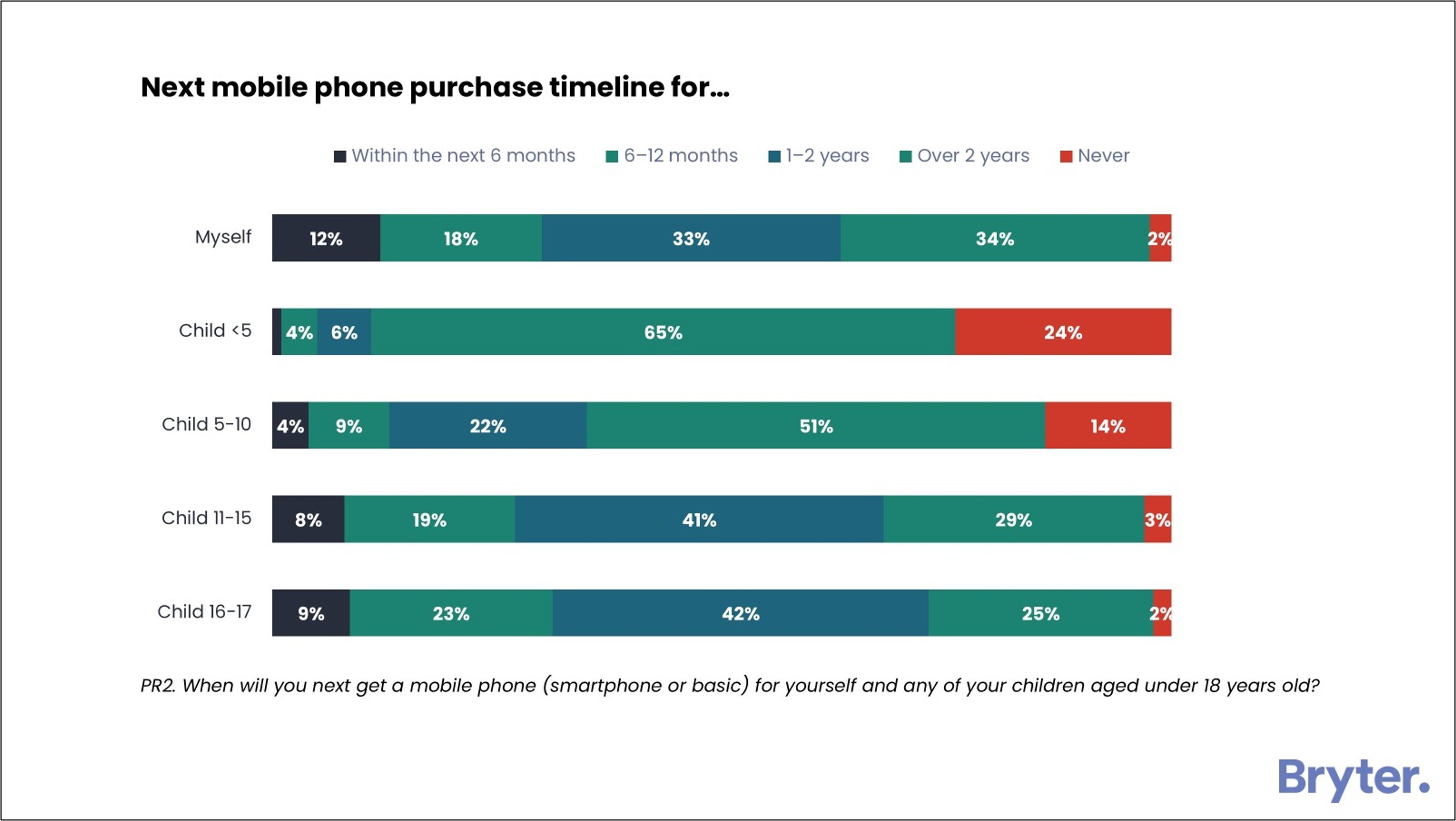
However, unless we see a major shift in behaviour in the next few years these stated intentions are unlikely to be true, as 91% of kids aged 11+ currently own some form of mobile device, the vast majority of which are smartphones.
We can see in the data that ownership of mobile phones jumps significantly from the 5-10 age group to the 11-15 age group. Previous research by Bryter has shown that the transition from junior to senior school is a pivotal moment for device ownership, as children become more independent often travelling to school and back without parents. Owning a phone supports greater autonomy and gives parents a way to stay in touch and monitor their children.
Smartphone or feature phone, what will parents buy their kids next?
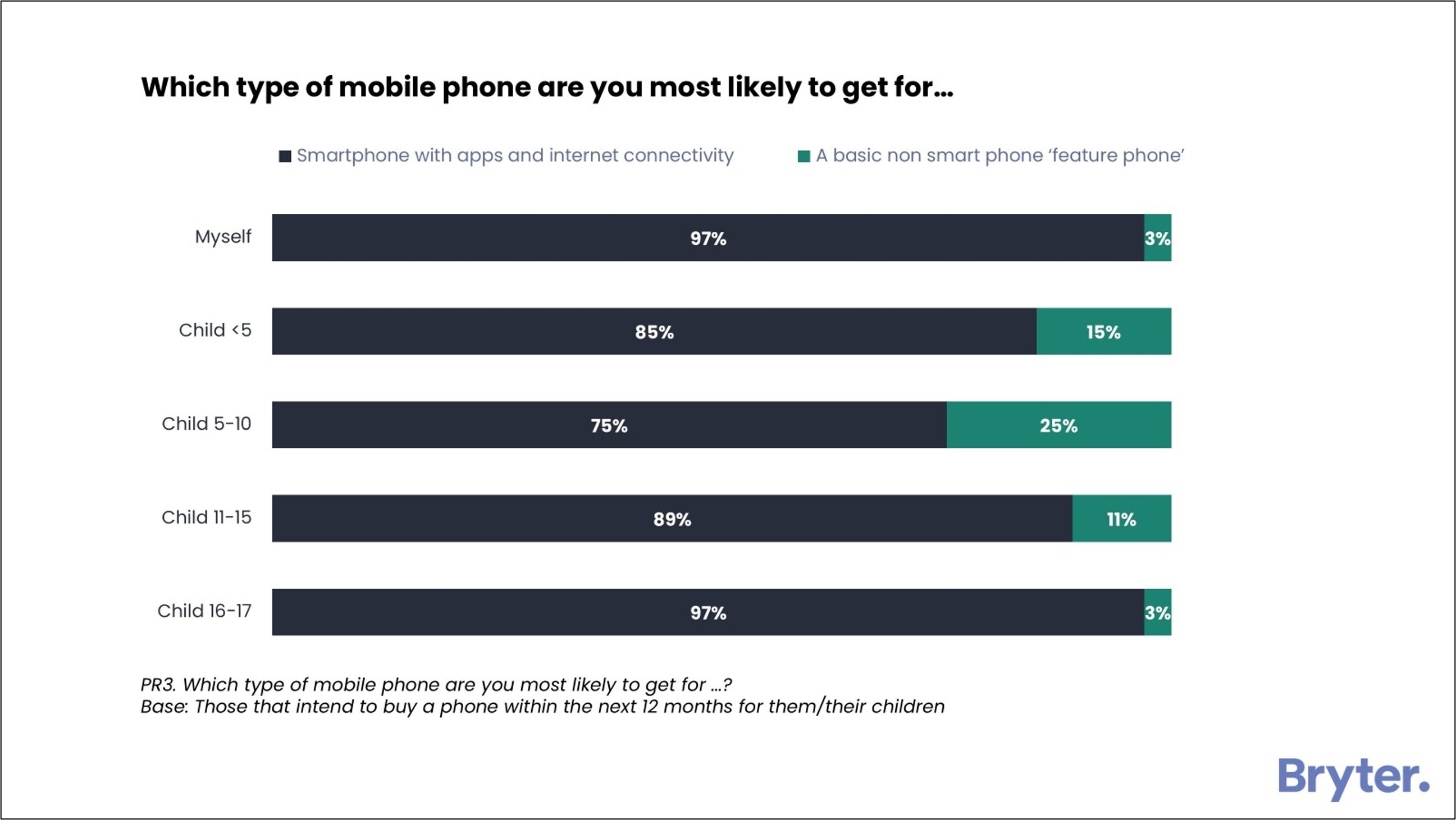
Of those who said they would buy their child a new phone in the next 12 months the distribution between smartphones and feature phones is broadly in line with current ownership statistics. This suggests that we are unlikely to see significant change in the types of devices purchased for children, and smartphones will continue to dominate in the future.
Parents will justify the purchase of smartphones for pragmatic reasons
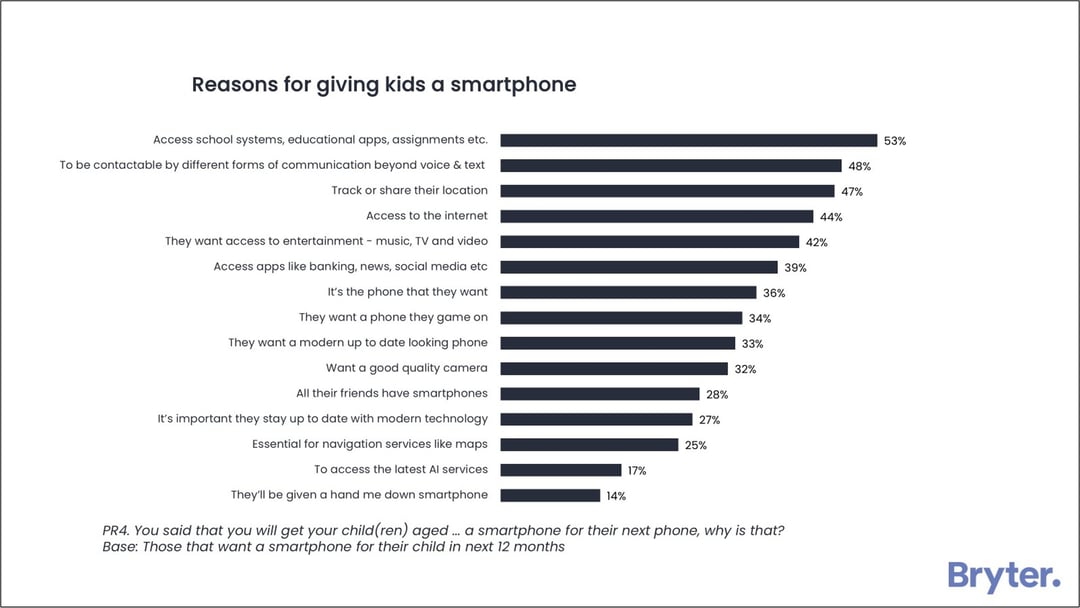 When asked why they will buy a smartphone as the next phone for their child pragmatism is the dominant theme, with the most popular answer being ‘to access school systems, educational apps and assignments’ (53%). Followed by ‘to be contactable by different forms of communication’ (48%) and ‘to track and share their location’ (47%).
What is likely downplayed in this is the role and influence of the child. Ask pretty much any child what type of phone they want and it will be a smartphone, ask them if they think owning a feature phone rather than a smartphone at school is a good look, and you’ll be likely to see them roll their eyes, yet ‘it’s the phone that they want’ was only mentioned by a third (33%) of parents and ‘all their friends have smartphones’ was only mentioned by 28%, as reasons for buying their child a smartphone.
The good, the bad and the ugly – how we feel about smartphones
Smartphones are a complex issue, and people often hold apparently contradictory views that reflect a general ambivalence towards the technology. On the one hand smartphones are often seen as providing many benefits.
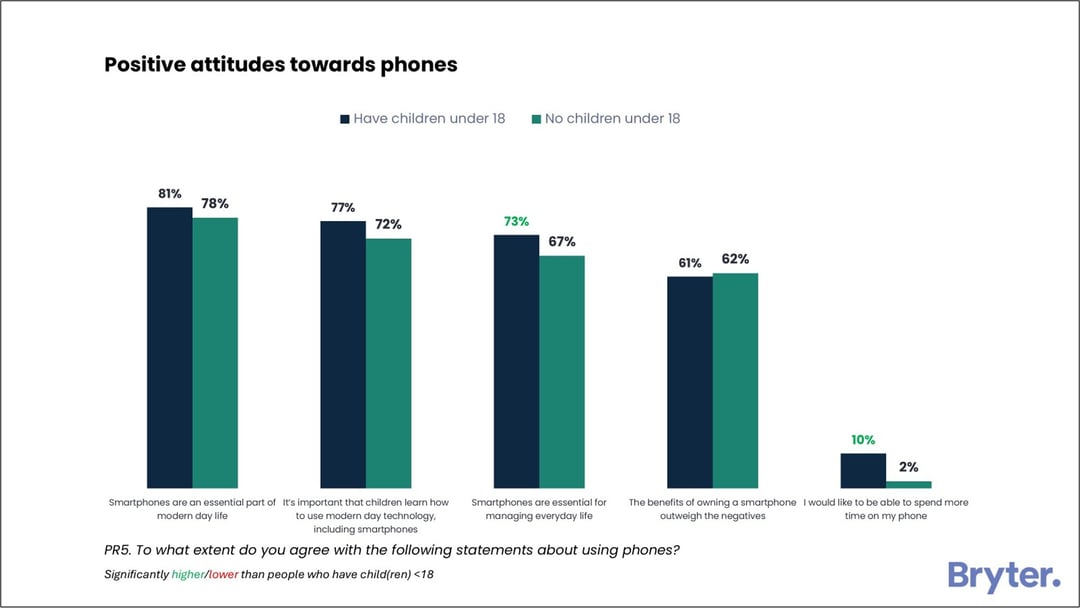
They are seen as an essential part of modern day life (79% agree), are essential for managing everyday life (69% agree) and the majority (62%) believe that ‘the benefits of owning a smartphone outweigh the negatives’
When it comes to children three quarters (74%) agree that 'It's important that children learn how to use modern day technology, including smartphones’, rising to 77% of parents with a child under 18.
There are also a lot of negatives associated with smartphone ownership and usage, but it’s here we see some differences between parents and those without children under 18.
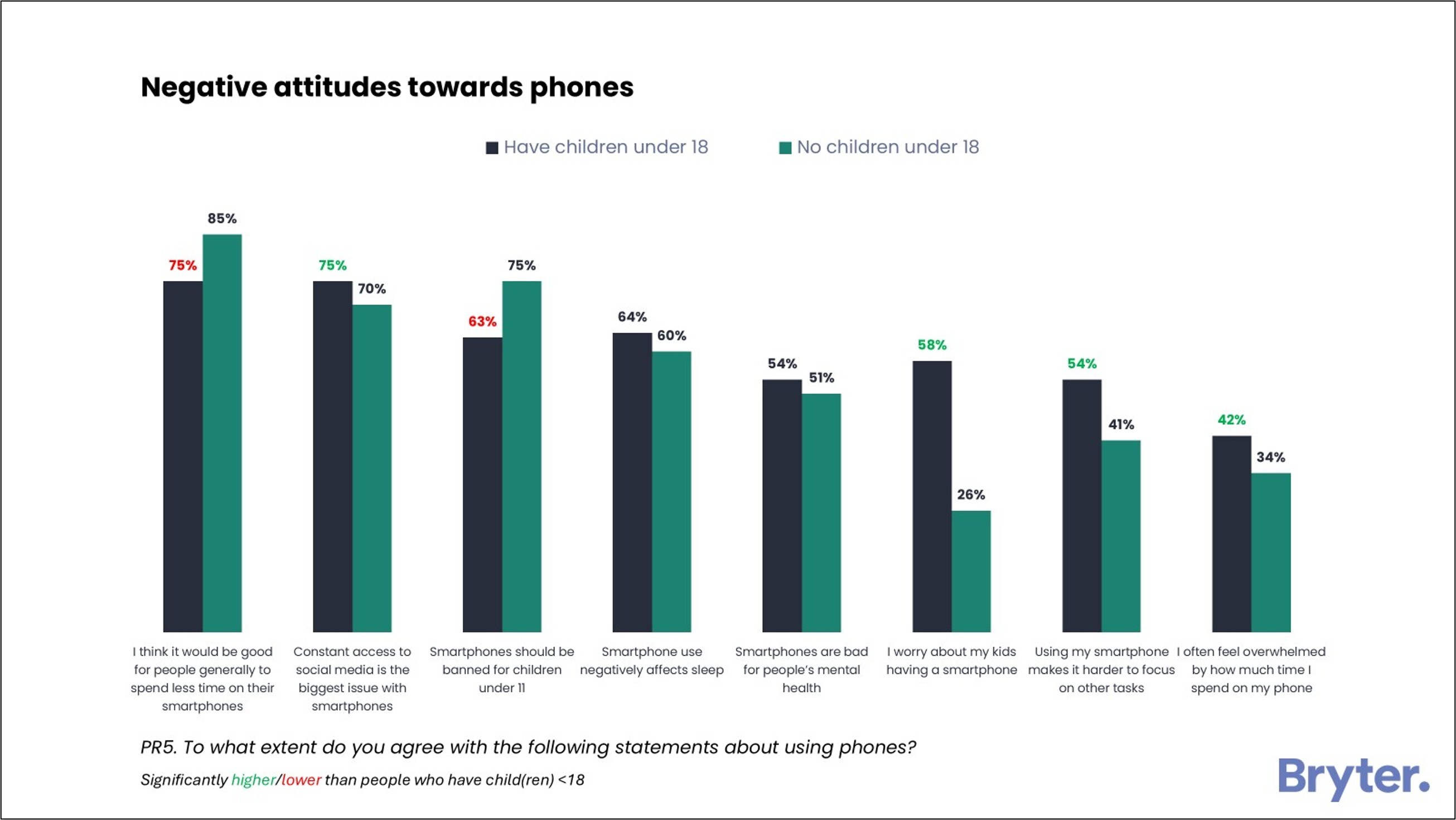
The general consensus is that we spend too much time on our phones, although this is a greater issue for those without children (85%) compared to of those with children (75%). Smartphones are also associated with negatively affecting sleep (61% agree), making it harder to focus on other tasks (45% agree) and a sense of feeling overwhelmed by how much time is spent on phones (36% agree). What sits behind this is not just the device though. Around seven in ten (71%) agree that ‘constant access to social media is the biggest issue with smartphones’
When it comes to our kids a significant proportion of UK adults think smartphones should be banned for the under 11’s. This is higher for non-parents (73%), than it is for parents (63%). This would imply a desire for state intervention when it comes to ownership, but this sits in direct contrast with the general consensus among both parents and non-parents alike that 'It's a parent's responsibility to manage how their children use smartphones’, a statement agreed with by 86% of parents and 90% of non-parents. These statistics highlight the complex nature of the issue when it comes to how and when children should have access to smartphones and who is ultimately responsible for this.
Summary and key takeouts
Overall, the findings point to a familiar tension: smartphones are widely viewed as essential and useful, yet there is deep unease about the consequences of early, always on access especially through social media.
- Smartphone ownership among adults is close to universal (96%), underlining how embedded the technology is in everyday life.
- For children, owning any mobile phone increases sharply with age particularly around the move into secondary school making the “when” of first ownership a key inflection point.
- Once a child has a phone, it is overwhelmingly likely to be a smartphone rather than a feature phone; smartphones dominate the mix in every age group and are set to remain the default choice for parents planning a purchase in the next year.
- Some parents say they will never buy their child a phone, but current ownership levels suggest intentions often soften as practical needs and independence grow.
- Parents tend to justify buying smartphones for pragmatic reasons such as school access, being contactable, and location sharing, while downplaying the influence of the child and peer pressure
- Attitudes to smartphones are ambivalent: many recognise benefits and see technology literacy as important, but large numbers also associate smartphones with too much screen time, poorer sleep, reduced focus and feeling overwhelmed. On balance though the benefits of smartphone ownership are felt to outweigh the negatives.
- There is a policy and parenting contradiction at the heart of the debate. Substantial support exists for banning smartphones for younger children, yet most people still see managing children’s use as primarily a parental responsibility.
Bryter’s take
UK Managing Director Seb Martin says
“The results from our latest survey reflect many of the tensions we have historically seen in relation to parents and smartphones. Although parents are worried about smartphone ownership we do not anticipate a move away from smartphones to more basic devices in the future. Kids want smartphones and parents will give them to them. If we are serious about limiting the negative effects of usage, the industry should be focusing its efforts on making it easier for parents to limit use and access of specific services. This will help to benefit the industry as well by opening up devices to wider audience of younger consumers by addressing the concerns that cause parents to restrict access until children are older’
Want more smartphone insights and data?
Download a copy of this report here
Access our smartphone and parents European report 'Phones, fears and future intentions' a three country study of 1800 adults of parenting age in the UK, Germany & Italy where you can compare the views of adults across three different markets and how they feel about smartphone usage for children
To learn more about the role market research can play in understanding audiences, development of technology and ensuring your product is designed to meet the needs of today's consumer check out our article on 'technology market research'